
The bill in French: how to ask for it and pay without hesitating
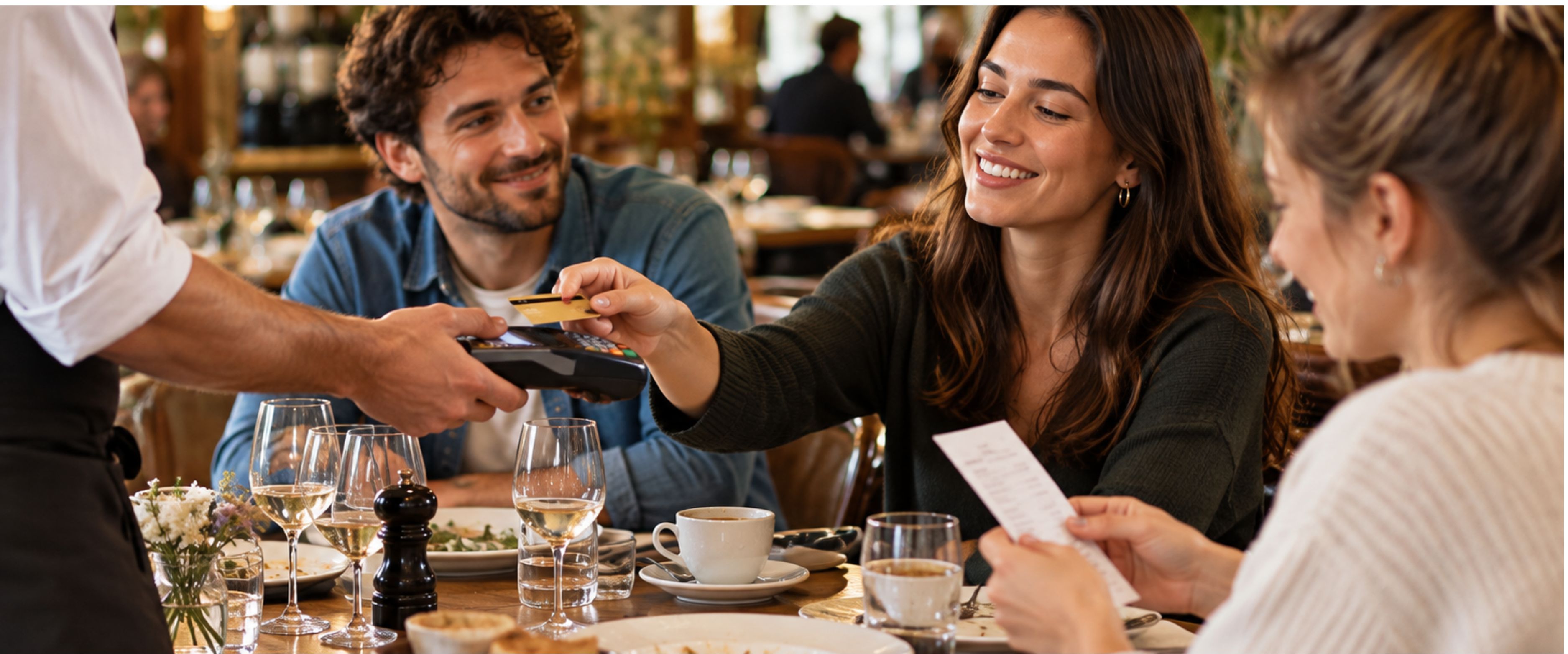
The meal is coming to an end in a small brasserie in Lausanne. Your friends are starting to check the time and you signal to the waiter. But when the moment comes to ask for the bill in French, you hesitate: which phrase should you use?
Don't worry, a few expressions are all you need to ask for the bill and answer the waiter with confidence, in French-speaking Switzerland as well as in France.
How do you say the bill in French?
At a restaurant, the bill is l'addition, a feminine noun. To ask for it, simply add s'il vous plaît, the equivalent of our "please".
Watch out for a false friend, though. The word le billet looks a lot like the English "bill", but it means a banknote or a ticket. Asked for at a restaurant, "le billet" would make the waiter smile, as he would think of a banknote or a ticket rather than your bill.
Before moving on to the phrases, here are the few words you need to know, with their English translation:
| English | French | Article |
|---|---|---|
| the bill (at a restaurant) | addition | l' (feminine) |
| the tip | pourboire | le |
| to pay | payer | – |
| please | s'il vous plaît | – |
These five words are enough for most situations, as they come up in almost every sentence spoken when it is time to pay. The article is worth remembering, too: even though the apostrophe hides it, addition is a feminine noun.
How to ask for the bill in French
You have finished your meal, you put down your fork and the waiter walks past a few metres from your table. Now is the moment to know which phrase to use.
Once you have the vocabulary in mind, all that is left is to choose the right phrase. One phrase works everywhere, while a few variations let you adapt your tone to the place and to the person in front of you.
The classic phrase
To ask for the bill, please, the simplest phrase is:
L'addition, s'il vous plaît !
Picture the scene: you simply catch the waiter's eye, smile and say "L'addition, s'il vous plaît !". No need to build a long sentence or look for a complicated turn of phrase. In just a few words, your request is perfectly clear.
Variations for asking for the bill
Of course, depending on the context, you may hear or use other expressions. In a small café, the exchange will often be very direct. In a more elegant restaurant, you may prefer a slightly more polite wording.
Here are the most common ones, with their English equivalent and their level of formality:
- On peut avoir l'addition ? ("Can we have the bill?"): very common and rather informal, ideal in a café or a brasserie.
- Je peux payer ? ("Can I pay?"): neutral, practical when you are alone at the table.
- Nous voudrions régler. ("We would like to pay."): formal and polite, perfect in a more elegant restaurant.
- J'aimerais payer. ("I'd like to pay."): polite and suitable for all situations.
- Garçon, l'addition ! ("Waiter, the bill!"): old-fashioned, today mostly used with a touch of humour.
These examples show that there is no real wrong phrase, only nuances of tone. When in doubt, the classic version is always the safest, and it will never make you seem impolite.
Paying the bill: useful phrases
The waiter finally comes back with the bill. You look at the amount, take out your wallet… and that is sometimes when a second set of questions begins. Card or cash? Together or separately? And if there are several of you, how do you simply say that everyone pays their share?
Here are a few phrases you might hear or use when settling your bill:
- Ça fait 48 francs 50. ("That's 48 francs 50."): this is how the total of a bill is announced to you.
- Séparément ou ensemble ? ("Separately or together?"): the classic question when there are several of you at the table. Simply answer ensemble (together) or séparément (separately).
- Je peux payer par carte ? ("Can I pay by card?")
- Vous avez de la monnaie ? ("Do you have change?"): useful if you only have a large note.
- Gardez la monnaie ! ("Keep the change!"): to leave the difference as a tip.
When it comes to tipping, habits vary from one country to another. In Switzerland, service is already included in the prices, and many customers simply round up the amount with a simple "Gardez la monnaie !". In France, service is also included and tipping is optional: people tend to leave a few coins on the table.
Right up to the last exchange of the meal
Think back to that end of the meal in Lausanne. With a few well-chosen words, the moment of paying, so simple in English, becomes an exchange like any other: you signal, you ask for the bill, you answer the waiter and you leave with a "Merci, bonne soirée !" (Thank you, have a nice evening!).
And so that the start of the meal goes as naturally as its end, find out how to order at a restaurant in French, from starter to dessert.